
India is moving at a fast pace toward its renewable energy goals. At the same time, the country faces a quiet but serious problem in its farming heartlands. Land that has fed generations is now being eyed for utility-scale solar parks, and nowhere is this tension sharper than in Punjab. With farmland under pressure from urban expansion, water table decline, and shifting cropping patterns, the state is at a crossroads where food production and clean energy goals seem to compete for the same fields.
This is where agrivoltaics in India is starting to change the conversation. By combining solar panels with active agriculture on the same parcel of land, this dual-use model offers a way out of the land-energy paradox. For a grain-bowl state like Punjab, the technology carries far more weight than just kilowatts generated. It supports food security, farmer income, and the country’s green energy targets at the same time.
Hartek Group, with deep experience across the energy sector in India, has been working at the intersection of solar engineering and grid integration. Through scalable solar solutions India needs at this stage of its transition, the company continues to support the kind of resilient infrastructure that can carry both the country’s farms and its renewable ambitions forward.
“Did You Know? Punjab contributes nearly 18% of India’s wheat production and around 11% of its rice production, yet it occupies just 1.5% of the country’s geographical area. With agrivoltaics in India gaining policy backing under MNRE’s PM-KUSUM scheme, states like Punjab are exploring how to add solar capacity without surrendering an acre of cropland to a panel-only future.”
The Land-Energy Paradox: Why Punjab Sits at the Center of It
Punjab’s agricultural identity is woven into India’s food story. The state has been a key pillar of the country’s grain supply for decades, and any conversation about reallocating its land carries political, economic, and social weight. On the other hand, India has committed to 500 GW of non-fossil-fuel power capacity by 2030, and solar must contribute a major share of that target.
The conflict is straightforward. Utility-scale solar farms typically need flat, open, sun-exposed land. Punjab has that in abundance. But that same land is also growing the wheat and paddy that feeds a significant portion of the country. Setting aside this farmland purely for solar would be a difficult trade-off.
Several pressures are converging at once:
- Shrinking agricultural margins are pushing farmers to look for secondary income streams.
- Groundwater depletion in Punjab has reached critical levels, particularly in central districts.
- Crop diversification efforts have been slow to take hold at scale.
- Rural electrification demands continue to rise alongside agricultural pumping loads.
- Renewable energy expansion plans require large tracts of land that the country cannot afford to lose to a single use.
Agrivoltaics offers a third path. It does not ask the state to choose between food and energy. It asks the land to serve both.
What exactly is Agrivoltaics?
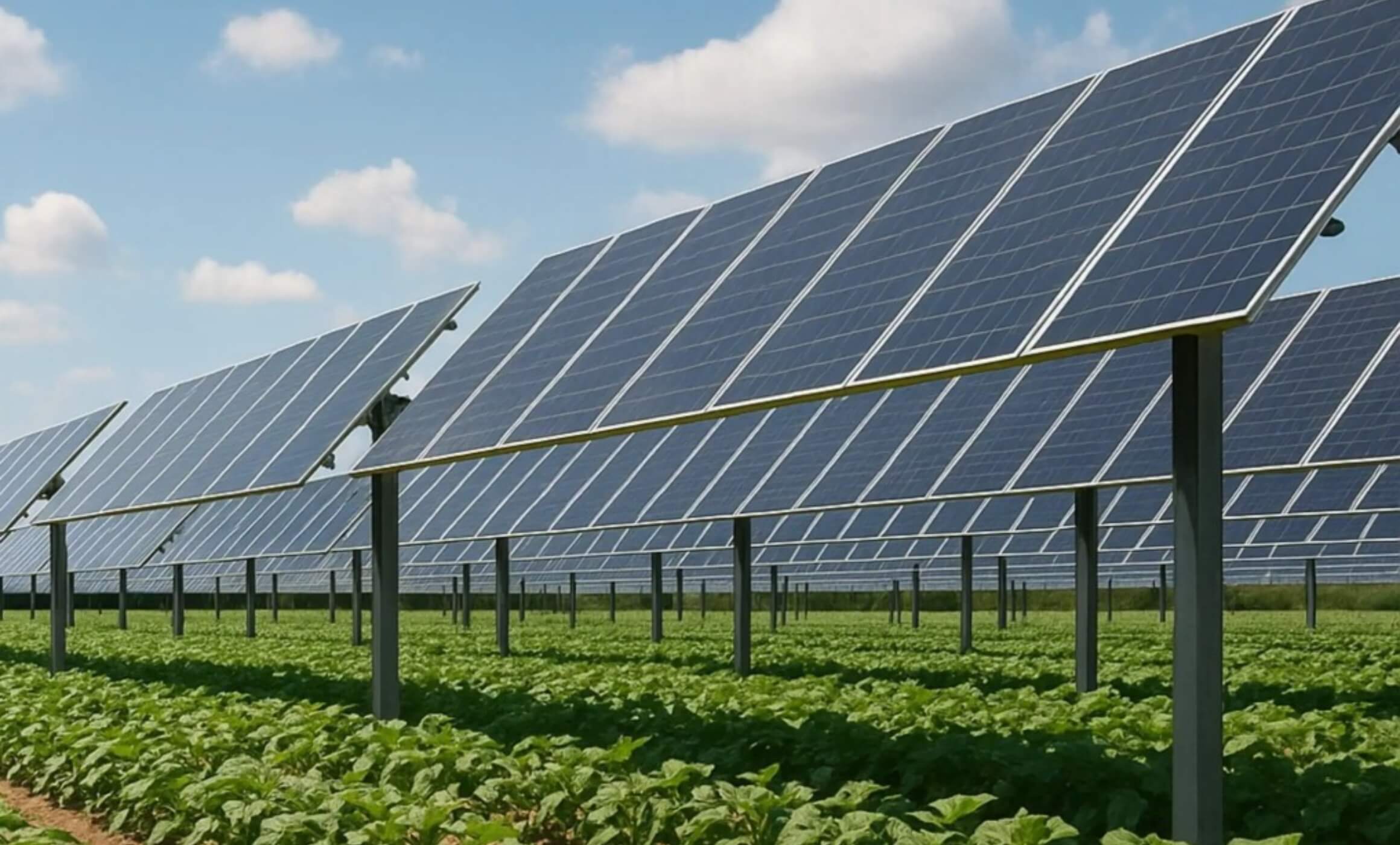
Agrivoltaics, sometimes called agri-PV or dual-use solar, is the practice of installing solar photovoltaic systems above agricultural land in a way that allows crops, livestock, or pollinator habitats to continue underneath. The panels are mounted on elevated structures, typically 8 to 15 feet above the ground, with enough spacing between rows to allow sunlight, rainfall, and farm machinery to reach the soil below.
The technology is not new globally. Germany, France, Japan, and parts of the United States have run agrivoltaic pilots for over a decade. What is new is India’s serious attention to the model, driven by the realisation that the country simply cannot afford to choose between feeding its people and powering its industries.
How the Setup Works on the Ground
A typical agrivoltaic installation in a Punjab context involves:
- Elevated mounting structures designed to clear tractor and harvester heights.
- Bifacial or semi-transparent solar modules to allow some light to filter through to the crop below.
- Row spacing optimised for the specific crop, usually wider than conventional solar farms.
- Drip irrigation or rainwater harvesting integrated into the panel array.
- Grid-tied inverters and balance-of-system equipment connected to the local distribution network.
Crops that perform well under partial shade work best. Research from ICAR and other Indian agricultural institutions suggests that turmeric, ginger, leafy vegetables, certain pulses, and some varieties of paddy can grow successfully under partial-shade conditions. In some cases, yields actually improve because the panels reduce heat stress and water evaporation.
Why Punjab Stands to Gain the Most
Among Indian states, Punjab has a specific set of conditions that make it a strong candidate for agrivoltaic deployment at scale.
1. High Solar Irradiance with a Long Sunny Season
Punjab receives roughly 300 sunny days a year. Solar generation potential is consistent and predictable, which makes the economics work for both the developer and the landowner.
2. Established Grid Infrastructure
Unlike remote desert regions where transmission has to be built from scratch, Punjab has a well-developed agricultural feeder network. Connecting distributed agrivoltaic systems to the existing grid is technically and commercially less complex.
3. A Farming Community Open to New Income Streams
With stagnating returns on traditional crops, many Punjab farmers are actively exploring options beyond wheat-paddy rotation. Lease payments or revenue-sharing arrangements from agrivoltaics can provide a stable second income, sometimes exceeding what the same land would generate from a single crop cycle.
4. Strong Need for Water Conservation
Shading from solar panels reduces evapotranspiration. In a state battling groundwater depletion, this is not a minor benefit. Some pilot studies suggest water savings of 20 to 30 percent for shade-tolerant crops grown under agrivoltaic canopies.
5. Existing Policy Framework
Punjab Energy Development Agency (PEDA) has been exploring rooftop and ground-mounted solar models for years. Aligning agrivoltaic deployment with PM-KUSUM Component A, which targets decentralised solar power plants on farmer land, is a logical next step.
Engineering Considerations for Agrivoltaic Deployment
Designing an agrivoltaic system is not the same as designing a conventional solar farm. The engineering brief is fundamentally different because the system has to serve two productive uses on the same footprint.
Structural Design
Mounting structures must be tall enough for farm equipment and strong enough to handle wind loads with longer columns. Foundations need to minimise soil disturbance so cultivation can continue. Galvanised steel and reinforced concrete footings are the typical choice for Indian conditions.
Module Selection
Bifacial modules capture light reflected from the crop canopy below, which improves overall generation. Semi-transparent modules with controlled light transmission help in fine-tuning shade levels for specific crops.
Electrical Infrastructure
Inverters, combiner boxes, transformers, and switchgear need to be positioned where they do not interfere with farming activity. Cabling is usually buried to protect equipment and tractors alike. Connection to the grid follows standard utility-scale or distributed solar protocols depending on system size.
Integration with the Wider Grid
This is where deep experience in the energy sector in India becomes important. Agrivoltaic systems, especially at scale, need substations, transmission infrastructure, and protection systems that can handle variable generation patterns. Smart inverters, SCADA integration, and reactive power management all play a role in keeping the grid stable as distributed agrivoltaic capacity grows.
Hartek’s work across high-voltage substation projects, switchgear systems, and EPC services for solar installations supports exactly this kind of integration. Connecting agrivoltaic generation to the broader electrical network in a way that strengthens rather than strains the system is a question of engineering discipline, and it is one of the reasons agrivoltaic projects need experienced infrastructure partners.
Hartek’s Role in Supporting India’s Solar Transition
Hartek Group’s contribution to India’s renewable journey spans across the value chain. From engineering and supply of switchgear systems to executing utility-scale solar EPC projects and developing high-voltage transmission infrastructure, the company has been part of some of the country’s largest clean energy programmes.
The relevance to agrivoltaics is direct. A successful agrivoltaic deployment is not just about installing panels above a field. It depends on:
- Reliable evacuation infrastructure that can carry distributed solar generation to the grid.
- Substation and switchgear systems engineered for renewable variability.
- Quality EPC execution that respects both the electrical and the agricultural use case.
- Long-term operations and maintenance support that keeps both the energy yield and the crop yield on track.
Through its work on large solar EPC projects, pooling substations for renewable plants, and integrated transmission solutions, Hartek continues to build resilient infrastructure that supports the country’s broader energy transition. For states like Punjab considering agrivoltaic deployment at scale, partnering with experienced engineering firms is essential to ensuring that ambition translates into working systems.
Key Challenges to Scaling Agrivoltaics
Agrivoltaics in India is promising, but it is not without friction. Several issues need attention before the model can scale:
Higher Capital Costs
Elevated mounting structures, custom row spacing, and specialised modules push the cost per megawatt above conventional solar farms. Until bulk procurement and standardised designs bring costs down, agrivoltaic projects need policy support to be financially competitive.
Limited Indian Data on Crop Performance
Most agrivoltaic research has been conducted in European or American climatic conditions. India needs more long-term field data on which crops perform well under panels in different agro-climatic zones.
Land Ownership and Lease Structures
Punjab’s land holdings are fragmented. Aggregating enough contiguous land for a viable agrivoltaic project often involves multiple farmers. Clear, fair lease agreements and revenue-sharing models are still being worked out.
Insurance and Risk Allocation
Crop failure, panel damage from hailstorms, and grid downtime each carry different risk profiles. The insurance industry is still developing products specific to dual-use agrivoltaic systems.
Awareness Among Farmers and Developers
Many farmers are unfamiliar with the model, and developers focused on conventional solar may not have the agronomy expertise needed for agrivoltaic execution. Capacity building is a real bottleneck.
Agrivoltaics and the Future of Renewable Energy
The trajectory of agrivoltaics in India will depend on three things: policy clarity, technical innovation, and successful pilots that prove the model works at scale. Punjab is well positioned on all three counts.
Central government schemes like PM-KUSUM already provide a framework that can be adapted for dual-use solar. State governments need to layer in tariffs, land-use clarity, and farmer incentives. Equipment suppliers are already developing modules and mounting systems tailored for agrivoltaic applications. And as more pilots in Maharashtra, Gujarat, and Rajasthan publish results, the case for replication in Punjab becomes stronger.
What this means for the broader energy sector in India is significant. Agrivoltaics expands the addressable land base for solar without taking land out of food production. It supports a more decentralised grid model. And it puts farmer income at the centre of the renewable transition rather than treating rural land as a passive input.
Key Takeaways
- Agrivoltaics in India offers a practical solution to the land-energy paradox by combining solar generation with active farming.
- Punjab’s high solar irradiance, established grid, and need for water conservation makes it an ideal candidate state.
- The model directly supports food security while still contributing to India’s 500 GW renewable target.
- Engineering integrity, grid integration, and resilient infrastructure are essential for agrivoltaic systems to perform reliably.
- Policy support, farmer-friendly lease structures, and quality EPC execution will determine how fast the model scales.
Conclusion
India’s energy transition cannot afford to be a zero-sum game between farms and solar farms. Agrivoltaics offers a way to keep both productive on the same parcel of land, and Punjab is one of the most logical places to scale the model. With the right combination of policy, engineering, and farmer participation, the state could become a national reference point for how to balance food security with green energy goals.
Reaching that point will require partners that understand both the technical depth of solar EPC and the wider responsibilities of grid integration. With years of experience delivering high-voltage transmission, substation, and renewable EPC projects, Hartek Group continues to support the kind of solar solutions India needs to build resilient infrastructure for the long term. As agrivoltaics moves from pilots to mainstream deployment, the work of building, connecting, and sustaining these systems will define the next chapter of the energy sector in India, and Hartek is committed to being part of that work.
Frequently Asked Questions (FAQs)
1. What is agrivoltaics and how does it work in India?
Agrivoltaics is the practice of growing crops and generating solar power on the same piece of land using elevated solar panels. In India, the model is being explored to support both farming and renewable goals without taking productive land out of food production.
2. Why is Punjab considered a strong candidate for agrivoltaic projects?
Punjab has high solar irradiance, an established grid network, and a farming community open to new income models. The combination makes it well-suited for scaling agrivoltaic deployment alongside existing agricultural use.
3. Does agrivoltaics affect crop yield?
Crop yield depends on the crop and panel design. Shade-tolerant crops like turmeric, leafy vegetables, and certain pulses often perform well, and in some cases yields improve due to reduced heat and water stress.
4. How does agrivoltaics support India’s renewable energy targets?
By using farmland for both food and solar generation, agrivoltaics expands the available land base for renewable projects. This helps India move toward its 500 GW non-fossil-fuel target without sacrificing food security.
5. What role does engineering play in agrivoltaic success?
Reliable mounting structures, smart inverters, substation infrastructure, and grid integration are critical. Quality engineering and EPC execution determine whether agrivoltaic systems deliver consistent generation and crop output over their full lifecycle.
Share:


